Passive Daylight Arrays: Channelling Ambient Light Without Inverters
High-latitude winters present distinct illumination challenges: days are short, sunlight arrives at extreme low angles, and interior living zones become dependent on artificial LED arrays burning grid electricity throughout workdays. Instead of converting photon energy to electricity via photovoltaic cells and back into light via solid-state LEDs, passive daylighting systems route raw solar flux directly into residential core rooms.
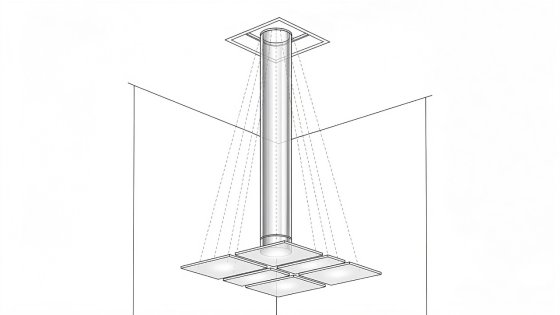
Optical Waveguides and Specular Multi-Layer Coatings
Modern tubular daylight conduits rely on advanced specular polymer films with specular reflectance exceeding 99.7% across the visible spectrum (380nm–750nm). Unlike conventional silvered glass mirrors which suffer light attenuation with every surface reflection, high-spec multi-layer optical film maintains over 85% luminous transmission even through multiple 45-degree elbows spanning vertical drops of six meters.
At the roof penetration point, a collector dome molded from impact-modified acrylic incorporates Fresnel prism ridges. These prisms refract low-angle morning and winter rays downwards into the tube core, capturing light that would otherwise glance off flat glazing.
Micro-Servo Heliostat Arrays
To maximize capture on roof pitches with non-ideal solar orientation, we integrate an autonomous heliostat louvre collector powered by a mini solar capacitor. A dual-axis astronomical algorithm calculated on an embedded Nordic nRF52811 computes the azimuth and elevation of the sun every ten minutes, adjusting two precision magnetic-encoder servo motors.
| Solar Elevation | Fixed Clear Glazing | Prismatic Dome | Active Heliostat Louvre |
|---|---|---|---|
| 8° (Winter Solstice) | 120 Lumens | 410 Lumens | 1,120 Lumens |
| 25° (Equinox Average) | 640 Lumens | 1,250 Lumens | 2,450 Lumens |
| 52° (Summer Peak) | 1,800 Lumens | 2,900 Lumens | 3,800 Lumens |
Thermal Isolation and Condensation Mitigation
A primary failure in poorly engineered solar conduits is thermal bridging. Warm, humid indoor air rising into an uninsulated attic light tube hits sub-zero roof metal, triggering condensation that drips down onto drywall ceilings. Our blueprints specify a hermetically sealed double-glazed thermal break cartridge seated directly within the building envelope insulation layer.
This barrier is backfilled with dry argon gas, achieving an overall thermal transmittance value of U ≤ 0.72 W/(m²·K), rivaling triple-glazed passive house windows while allowing pure full-spectrum natural daylight to illuminate kitchens and staircases.
Automated Dimming Shutters for Evening Cinema and Sleep
A continuous pipe of daylight can be disruptive during daytime rest or film screening. Our hardware assembly includes a bistable magnetic butterfly damper within the tube. Operating via a momentary 50ms electromagnetic pulse, the damper snaps between fully opaque and fully open without drawing continuous holding current.
Optical Modeling Files & Ray Tracing
Access our open optical ray-tracing datasets, acrylic injection molding dimensional specs, and servo motor driver schematics.
Inspect Soil Hydration Systems