Thermal Heat Harvesting: Battery-Free Ambient Domestic Sensors
A typical connected household with fifty edge sensors requires twenty to forty battery replacements every twelve months. This creates recurring maintenance friction, chemical waste, and unpredictable node outages in winter months. The solution lies in ambient micro-energy harvesting from thermodynamic gradients already present in domestic heating systems.
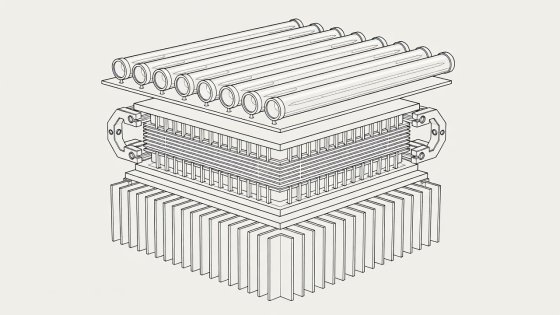
The Physics of Domestic Thermoelectric Generation
Thermoelectric generators (TEGs) exploit the Seebeck effect: when heat flows through semiconductor couples composed of p-type and n-type doped bismuth telluride (Bi2Te3), mobile charge carriers diffuse toward the cold side, generating an open-circuit voltage proportional to the temperature delta (ΔT).
In hydronic radiant heating systems common across Nordic homes, water circulating at 45°C to 65°C runs through exposed metal pipework just centimeters away from ambient room air at 21°C. A differential of 25°C to 40°C represents a dense, continuous energy reservoir.
Ultra-Low-Voltage Step-Up Converters
The core electronic challenge is voltage amplitude. A single 40mm x 40mm TEG experiencing a 20°C ΔT generates merely 350mV to 500mV—far below the 1.8V to 3.3V operating voltage demanded by modern microcontrollers. To bridge this threshold, our blueprints incorporate resonant transformer boost converters like the Linear Technology / Analog Devices LTC3108.
| Thermal Delta (ΔT) | Raw TEG Voltage | Boost Output Current | Capacitor Fill Time (0.1F) |
|---|---|---|---|
| 10°C | 180 mV | 42 μA @ 3.3V | 18.4 Minutes |
| 20°C | 360 mV | 115 μA @ 3.3V | 6.2 Minutes |
| 35°C | 680 mV | 290 μA @ 3.3V | 2.1 Minutes |
| 50°C | 1050 mV | 580 μA @ 3.3V | 54 Seconds |
Energy Budgeting in Duty-Cycled Sensing
Even at 115 microamps continuous output, continuous radio transmission would drain harvested reserves instantly. Therefore, firmware design relies strictly on deep sleep states. Between measurement intervals, the micro-controller draws less than 400 nanoamperes in System-Off state.
Every 60 seconds, an ultra-low-power timer wakes the analog-to-digital converter, samples ambient temperature, humidity, and barometric pressure in 4 milliseconds, transmits a single 15-millisecond encrypted Thread packet (drawing 14mA peak), and returns immediately to dormant sleep. The net energy consumed per duty cycle is approximately 32 microjoules, safely below the energy delivered by the thermal harvester.
Mechanical Clamping and Thermal Interface Design
Electronic efficiency is meaningless if the mechanical thermal junction is compromised. Standard copper pipe clamps introduce point contact with poor heat transfer. Our physical enclosure incorporates CNC-machined curved aluminium saddles lined with high-conductivity graphite thermal pads (15 W/m-K).
On the cold side, an extruded finned heatsink faces vertical convective drafts created by room air circulation, preserving the critical thermal gradient without noisy auxiliary cooling fans.
Bench Schematics & Thermal BOM
Review the verified component bill of materials including 1:100 step-up transformers, supercapacitor selection parameters, and clamp dimension files.
Examine Next Subsystem