Matter Mesh Bridges: Sovereign Local Networking for Resilient Living Spaces
Modern household automation is plagued by deliberate vendor partitioning. Every major commercial manufacturer has historically demanded its own proprietary wireless bridge, consuming electrical sockets and saturating 2.4 GHz spectrum channels. These closed bridges perform zero edge compute; their primary function has been acting as proprietary telemetry funnels to commercial cloud servers.
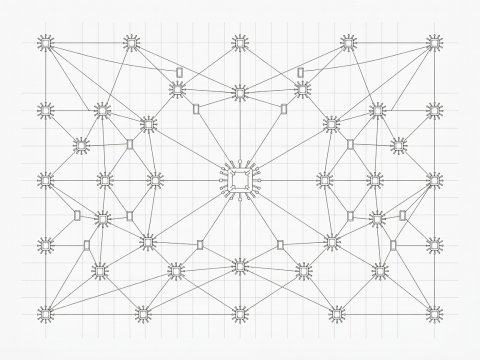
The Thread Mesh Topology: Self-Healing Domestic Connectivity
The transition to IPv6-based Thread over IEEE 802.15.4 transforms how edge nodes converse. Instead of speaking proprietary application dialects, every sensor, dimmer, and valve receives a discrete IPv6 address. This eliminates protocol translation bottlenecks entirely.
A resilient home setup utilizes an OpenThread Border Router (OTBR) running on an open-spec single-board computer paired with a Nordic Semiconductor nRF52840 or nRF5340 coprocessor. Because the bridge functions as a standard IP gateway rather than a proprietary translator, communications between switches and luminaires remain strictly local.
Physical Bridge Hardware Specifications
Building an autonomous border gateway requires thoughtful component selection to eliminate thermal throttling and radio interference. Below are the verified bench measurements for our reference lab node:
| Subsystem | Reference Component | Operating Value | Design Requirement |
|---|---|---|---|
| Radio Coprocessor | nRF52840 Multiprotocol | +8 dBm PA, -100 dBm Sensitivity | External SMA Dipole Antenna |
| Host Compute | Allwinner H616 Quad A53 | 1.2 GHz Throttled | Passive Aluminium Heatsink |
| Ethernet Uplink | Gigabit RTL8211F PHY | Full Duplex local bus | Cat6 Shielded Backhaul |
| Power Conditioning | TI TPS62840 Buck Converter | 94% Efficiency at 60mA | Clean 3.3V Line with < 5mV Ripple |
Pairing Security via Open Cryptographic Attestation
Commercial hubs typically authenticate devices via proprietary smartphone applications that harvest geolocation data, Wi-Fi passwords, and contact lists. In contrast, local Matter devices implement public-key cryptographic attestation. During node provisioning, the commissioning tool verifies the device's Device Attestation Certificate (DAC) against a locally cached certificate revocation database.
At no point does the device communicate outside the local VLAN. Network packet inspections reveal zero DNS inquiries to third-party endpoints, ensuring that even if external transatlantic fiber links are severed, household switches operate without a millisecond of disruption.
Handling Network Partitions and Node Resiliency
One of the primary failure modes of legacy Zigbee implementations was the "single point of failure" coordinator. If the coordinator powered down, the entire network froze. With Thread border routing, redundant border routers can be placed on multiple floors of a residence.
Should the ground-floor router lose power during maintenance, the secondary node on the upper level seamlessly claims the Leader role across the mesh within 200 milliseconds. No device re-pairing is needed; routing table propagation happens autonomously via mle (Mesh Link Establishment) packets.
Download Complete Gerber & Firmware Blueprints
All schematics, KiCAD PCB files, and Zephyr RTOS firmware configurations are maintained under open distribution licenses. Build your own zero-cloud gateway today.
Request Raw Schematic Packet